








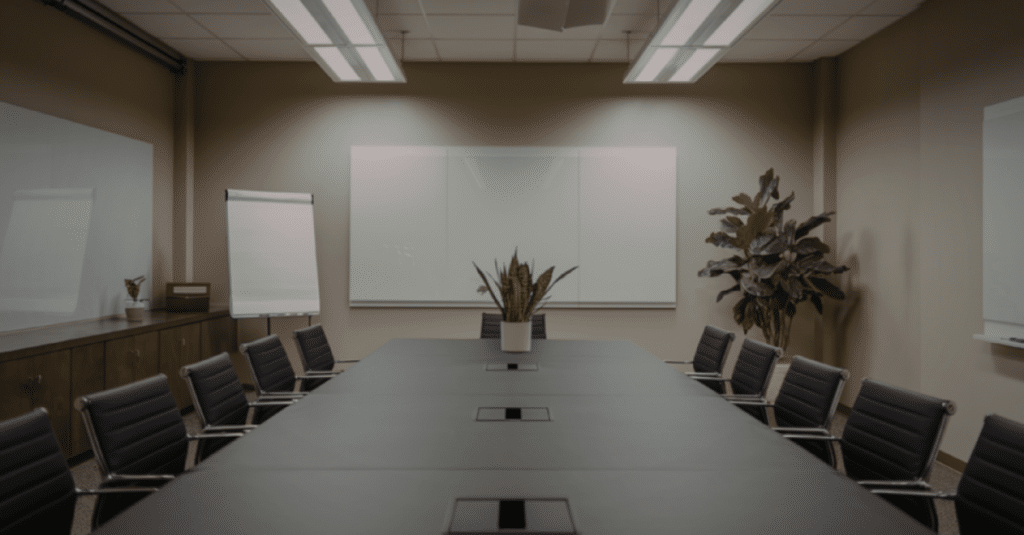
Last quarter, I sat through a two-day planning session in a company’s own boardroom. By 10:30 am on day one, someone had slipped out to “just deal with something quickly.” By lunch, three people were half-reading their phones under the table. By day two, the group had produced a strategy that looked suspiciously like last year’s strategy with different numbers on it.
Nobody thought to question why they were doing it in their own building.
This is more common than most leaders want to admit. The boardroom feels like the logical choice. It’s available, it’s free, and it has a projector and decent chairs. But that logic is exactly the problem. Planning sessions aren’t meant to be logical. They’re meant to be generative. And the office works against that in almost every way.
The Building Remembers Everything
Walk into your own boardroom, and your brain immediately starts pattern-matching. That’s the chair where the CFO always pushes back. That’s the wall where you presented last year’s results. That’s the table where the restructuring was announced. Environments carry memory, and memory pulls people backward: toward precedent, toward caution, toward the way things have always been done.
You can’t ask people to think differently while surrounding them with reminders of how they normally think.
The Hierarchy Doesn’t Take A Day Off
There’s something about sitting in the same seats, in the same room, with the same sightlines to the CEO, that keeps everyone in their lane. The person who would have challenged an assumption in a neutral space stays quiet. The senior leader who dominates regular meetings dominates this one too. The same voices speak. The same ideas surface.
Off-site, something loosens. It’s subtle but real. When the physical context shifts, the social context shifts a little with it. People take up different spaces.
“Urgent” Is Always One Door Away
The office is a living organism. It breathes problems at you all day. And when your planning session is being held twenty metres from everyone’s desk, the problems know where to find them.
Someone’s assistant knocks. A crisis lands in someone’s inbox. A participant excuses themselves for five minutes and comes back twelve minutes later with the unmistakable look of someone who’s now thinking about something else entirely.
Deep strategic thinking requires sustained attention. Sustained attention requires protected space. Your own office is, by definition, not a protected space.
Comfort Is The Enemy Of Clarity
There’s a reason that some of the best ideas come from slightly uncomfortable situations. A long flight, a walk, an unfamiliar city. Mild disruption activates different thinking. When everything is familiar and frictionless, the brain does what it always does. It takes shortcuts. It reaches for what’s already worked.
A new environment, even a modestly different one, creates just enough productive tension to make people more present, more curious, and more willing to question what they’d normally accept.
What You’re Actually Signalling
When you hold your annual planning session in the usual boardroom, you’re sending a message whether you intend to or not. The message is: This is just another meeting.
The venue is a signal. Getting on a bus together, arriving somewhere unfamiliar, eating meals you didn’t order from the usual place. All of it tells people that what’s about to happen is different. That it matters. That they should bring a different version of themselves.
You can’t manufacture that signal in your own building.
The good news is that “off-site” doesn’t have to mean expensive or elaborate. A local hotel meeting room. A hired space across town. Somewhere without your logo on the wall and without your staff in the corridor.
The distance doesn’t need to be geographic. It just needs to be psychological.
Get out of the building.